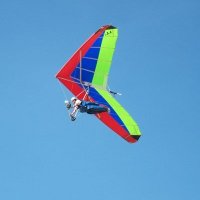

[youtube]http://www.youtube.com/watch?v=_sLpmAXbVD0[/youtube]
On Saturday, May 25, I had gone up on the 10 o'clock truck for an early flight. By the the time we got up the hill and set up it was about noon. When I carried my glider to launch the wind was straight in at about 12 mph and had been very smooth the whole time we were on the mountain. I was assisted by one wireman who had just moved to the left side wire. Everything seemed good, and I lifted the glider and called "clear." At this point I missed some indication on the lower streamers that a gust was coming. The wireman did see the signs and tried to give me some warning. However, at the time I was thinking more about the launch and I just thought he was informing me that he was clear of my wires. Before I started my run the gust hit, lifting the left wing and pulling me forward and to the right. Thinking that I was launching, the wireman hesitated to grab the side wire, and I did not react quickly enough to ask for his help. I was unable to control the glider, and I was ultimately dragged about 15 feet down and to the right of launch. The glider turned to the right, the nose went into the hill side, and the glider was flipped over with me dangling like a rag doll from my hang loop draped over a down tube.
As things stand, I got off very easy. The only damage was two new tears in my leading edge and a small dent in my pride. After pulling all the battens and carefully inspecting the glider, I was able to launch a while later and enjoy a nice flight.
So, what did I learn from all this? First of all, even a seemingly trivial launch can jump up and bite you if you aren't paying attention to all the signs and if you're not ready to act quickly. You cannot be complacent, even in what appear to be benign conditions. I had not felt a gust all day, but it only took one to flip me over. Second, when you have something like our streamers below launch, make sure you use them. They can give you a bit of an advance warning, but only if you watch them. Third, the instant you know you need help from the wireman say something to let him know. This is particularly true if you have already called "clear." Finally, after an incident like this check your equipment very carefully. It took me a couple of flights to fully realize that the position of my hang loop had shifted, and my trim point had been pushed down to mushing region of a stall.
I'm sure there are more things to be learned from this. So, feel free to offer your advice.



 Cute Jim! I laughed out loud. (LOL) Sorry if it came off as a brag. I was just trying to show that it was right on the edge all the way through the launch, which was quite long.