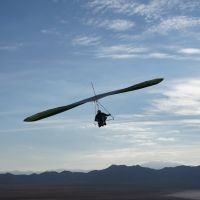
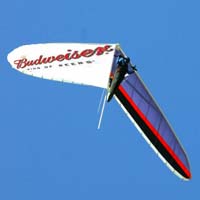
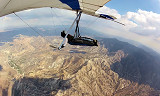
Yes Oscar, you mentioned this is the LZ on Sunday. It has an air brake on the tail operated with a VG style pull cable. It looks to be much safer than throwing a drogue chute - but how much drag does it produce when not in use? You also mentioned, and I saw in one of the pics on that site, it has a variable camber to the wing. Somehow the wing bends to create more lift. It looks like it has extra battons mounted on their side and they twist up into position.
Here,s how the wing works,It looks like A cam and lever hooked up to a VG style rope.when you pull the rope the cam pushes up on the carbonfiber tube which pushes up on the batens changing the camber. .I can't find anything on how much drag it produces in flight ,but when ativated I'm sure theres quite a bit of drag.http://www.hanggliding.cz/servis/servis ... u-za-letu/
Cool Concept, However its interesting that the video doesn' t show the pitch change while activating the air brake. And I would wonder if there is added bar pressure to overcome or does it hinge in flight to lighten bar pressure?
"Keep thy airspeed up, lest the ground come from below and smite thee".
William Kershner
At 22 seconds into the landing clip you can see the glider nose up slightly. It could be from a weigh shift and you can't see what his left arm is doing.
I thought I saw an Atos with a similar fixed tail configuration - so I doubt it produces much noticeable drag. I wonder if a Moyes Lightspeed could be easily retrofitted with the tail, or the cam camber modification?
The air brake will not cause a pitch change once fully activated because it is set to stop perpendicular to the airflow (at 80 degrees as measured from the keel). There would be very little drag on a wing like this (when NOT activated as an air brake) and it would also increase pitch stability, making it harder to tumble. I believe that this is the reason the Atos's use it. They did not have it when first released. I imagine that a Litespeed could be set up with this if someone wanted it bad enough. Maybe Phil will be interested - it might have prevented his tumble, and besides, he likes to tinker with his glider.
As far as the camber change, it appears to me that it is related to the VG setting. Notice that the camber decreases when the VG (crossbar) is pulled back. It looks to me like it contacts and pushes against straps between the upper and lower battens, pulling them closer together and causing the camber to decrease. This would increase the speed capability at full VG. Very cool idea.
What language is that link? Eventually someone will be able to read what it says and find out exactly how that camber change works.
Thanks for the link to the English version. It certainly helps but the translation kind of sucks. It did confirm that the air brake was originally installed as a pitch stabilizer that also happens to work as an air brake with the addition of the movement lever. However I failed to find a decent explanation of mechanism for the changing wing airfoil.
Jonathan, thanks for the Czech/English translation.
Instead of trying to reverse engineer it, they might send Sylmar a demo glider, for sale later. Let some experienced pilots (with cameras attached) test it on this range flying with Lightspeeds and T2s. Wills Wing and Moyes sell a lot of gliders here but these former East European Warsaw Pact countries should be allowed to compete in the free market so everyone can benefit.
A homemade experimental air brake could fail, possibly deploying at a 45 degree angle and pitching the nose up into a stall. Or if its too big it might just float the glider down to the ground nose first like in a reserve parachute deployment.
If something were reverse engineered it all could be tested by mounting a glider on a truck. If the glider was mounted to a gimbal that allowed a few degress of freedom and then driven at normal landing speeds as well as just below VNE the tailplane could be tested to see what it does at various angles of deployment. If two tailplane were used. One above and one below that both actuate evenly it would counteract any pitch change during deployment.
My Falcon 1 would hardly benefit from this, but I do know how to vacuum bag composite wings and it would make an interesting project one day
addicted2climbing wrote:If something were reverse engineered it all could be tested by mounting a glider on a truck. If the glider was mounted to a gimbal that allowed a few degress of freedom and then driven at normal landing speeds as well as just below VNE the tailplane could be tested to see what it does at various angles of deployment. If two tailplane were used. One above and one below that both actuate evenly it would counteract any pitch change during deployment.
My Falcon 1 would hardly benefit from this, but I do know how to vacuum bag composite wings and it would make an interesting project one day
Just a thought.
Marc
Yes that would be an interesting project ,and you would have twice the drag.