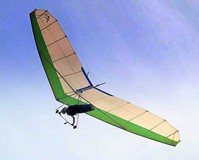
There's no manual for the generic knee-hanger harness, so I've put together everything I know. Please post any corrections or additions. Disclaimer: I’m not an instructor. You should consult a certified HG instructor before making any changes to your hang gliding equipment.
The knee-hanger harness, first harness of most students, has the benefit of simplicity, low cost and weight, and serves well for multiple hops on training slopes as well as high-altitude flight. It is often maligned as uncomfortable, restrictive for launch and landing runs, and aerodynamically challenged. Instructors fly knee-hangers without complaint, however, suggesting that comfort also includes state of mind and the ability to relax.
The knee-hanger suspension hangs the pilot from lines intended to distribute body weight as equally as possible without benefit of any rigid structure. Lines are attached at three points: shoulders, hips, and knees. Adjustments to the length of these lines can and should be made.
Start by hanging in your harness at home and photographing yourself with a digital camera. Harness adjustments rely on judging how it “feels� and how it “looks� simultaneously, so an objective picture is required. You should be horizontal to the ground or a bit head-up, for comfort. You should feel balanced. To rock up into the landing position should require a chair in front of you, simulating downtubes.
You should feel equally weighted at shoulders, hips and knees. If you seem to be falling out of the back of the harness, or if your knees feel very heavy, lengthen the shoulder straps to move your body forward in the harness. This may require changing the length of shoulder and/or knee lines. Mark the old positions with tape so you can return to them if necessary.
A common complaint about knee-hangers is that the knee-lines restrict running. They must be long enough to permit running but short enough to hold the legs up in flight. Remember, there’s no need to be horizontal while flying, a heads-up position costs nothing on a single-surface glider. Experiment with shoulder strap and line lengths. Don’t give up. The alternative of detaching knee-lines before landing (in order to run better) leaves knees unprotected. With knee-lines attached, you can still enjoy the great advantage of knee-hangers, which is the ability to hang upright while landing.
(This is accomplished by a pre-landing “monkey-move� in which the knees are splayed momentarily, one at a time, so as to place the pilot’s full weight on the knee-lines. The knee lines move from their position behind the pilot’s back to a new, weight-bearing position at each hip. The pilot appears crouched and upright, his body compact under the carabiner. Such an upright position makes landing easier).
As many pilots discover to their surprise, you can’t test your harness adjustments at home, because you need a slope to run down and a glider to lift you. Make sure to try out adjustments on the training hill before any altitude flight.
Hang Strap length. If all else fails in the search for comfort, consider that, theoretically at least, a shorter hang strap provides less “squeeze� pressure on the pilot. With a long hang strap, the harness suspension lines are shorter. With a short hang strap, the suspension lines are longer (for the same hang-check) and compress the pilot less from head to foot. For some body types, experimentation with hang strap length may be of value.
TIPS
--When donning knee-hangers, the tangling factor is reduced by first clipping the carabiner to a flying wire, and then maintaining slight pressure as you wiggle in your gear.
--Knees are vulnerable in training (and beyond). Commercially available hard-plastic knee pads can be adapted to your knee hangers by a hang gliding or sailmaker’s shop.
--Some relief from shoulder pressure can be obtained by adding padding to shoulder straps, or wearing rugby shoulderpads.
--Clean up all dangly parts. No need to cut off the tails of harness straps and lines, just fold them back against the weight-bearing part and secure with black plastic electrician tape.
--If your shoulder straps keep falling off your shoulders, tie them together with a bit of shock cord that will still let you enter and exit.
MODIFICATIONS (ask your instructor first):
Kick strap. This single greatest improvement introduces a footrest by which the pilot can straighten his knees and pressure his shoulders for a more secure ride.
To make a kick strap, tie a length of Dacron or other low-stretch line to the towing loops on the apron of the harness. Use a piece of plastic pipe for the footrest. If you just thread the line through the pipe it will roll and your feet will slip off. Instead, drill a hole through one side of the pipe wall ½ inch from each end and thread the line through the hole, then through the pipe. Adjust the length of the line so you can push against the footrest with your feet.
The kick strap must be held out of the way during launch and landing. Holding the kick strap line in your mouth is no longer recommended. Fix an open-face hook on a top tow-loop and place the line over it for takeoff. You can use Velcro, or a snap hook with the snap-lever entirely removed. Attach the modified hook to the harness with a few turns of electrician’s tape, so it can break away easily if fouled.
Deploy the kick strap only when safely away from the hill. Just flick it off the chest hook and it will fall into position. Find it with your foot and prone out. For landing, replace the kick strap on its hook during your pre-landing checklist
Spreader bar. Some pilots complain of compression of their chest from the harness mains, especially in flights over one hour. This is because knee-hangers lack the spreader bars of advanced harnesses. But you can add one easily.
Cut a piece of plastic pipe about the width of the harness. Drill a hole through each end and thread the harness main lines through them, holding in place by knots top and bottom. The spreader bar should be about six inches above your back. Its job is merely to hold the lines apart so they don’t squeeze you. Such a spreader bar actually makes the rig less inclined to tangle. Test it at the training hill. Be sure to test it with a Camelback, if you fly with one.
###
Knee-hanger harness "manual"
Moderator: Chip
Continued
Notes: Where should the knee lines attach to the pilot? Wills Wing says below the knee http://www.willswing.com/pdf/manuals/OM ... arness.PDF but High Energy says on the knee itself http://www.highenergysports.com/jrkneehanger.htm
Some believe the knee-point attachment relieves running problems.
###
Some believe the knee-point attachment relieves running problems.
###

NMERider wrote:OP wrote:And as the person responsible for cleaning up these posts I:leocruz wrote:Pipe hanger support.....
1. Delete the post
2. Delete the identity
3. Ban the IP address from whence it came (India origin)
It's pretty much "whack a mole" but I get a perverse pleasure from giving these posts minimal air time.
Mike
I did notice that Mike. The deleted post looked to me like the work of a bot and not a person. Possibly even generated from a zombie PC. I have Kaspersky running root kit detection on our PCs to avoid becoming part of a bot net.Mike M wrote:You'll note that I also deleted the quoted reference to the spam website....
Christian,
I've always argued that the knee hanger harness will allow a pilot to run as fast on launch as any other harness, and I occasionally demonstrate it with extremely short knee hanger ropes. Failure to do so is usually due to weaknesses in launch technique and not necessarily in harness adjustment. This is very often disputed among instructors and students.
With a pod or a cocoon harness, at the moment of lift off, the pilots legs remain completely un-encumbered with respect to running. This is because the harness mains support all the pilot weight and they terminate near the pilots hips. This is not so with most knee hanger harnesses because the knee hanger ropes themselves support much or all of the pilots weight when in the upright (take-off and landing) body position. During the launch run, as the glider rises higher and higher, and develops more and more lift, the knee hanger harness lifts more and more on the backs of the knees, thus restricting the run.
The solution to this problem as taught by those familiar with the knee hanger harness is to teach students to avoid relatively high angles of attack during the launch run. Since angle of attack is a prime determinant of lift, and lift is restricting the run, reducing the angle of attack reduces the upwards lift of the glider and frees the legs to make long strides.
Recognizing the amount of lift the glider is producing during a launch run is a very valuable pilot skill, regardless of what kind of harness the pilot is wearing. A pilot launching with too high an angle of attack in a cocoon or pod harness, simply gets picked up too soon and can't run any further or faster anyway. But in this case, he can't blame the problem on harness lines restricting his run. Any inability to recognize, manage and manipulate these lift forces of lift during the launch run, poses danger to a pilot and is often witnessed by the following...............
1. getting picked up too soon, with too few running steps, or with too high an angle of attack. Solution: reduce the angle of attack to keep the pilots feet on the ground in order to accelerate to a higher launch speed.
2. feeling like the knee hanger ropes are restricting your run. Solution: reduce the angle attack to reduce the upward knee hanger forces that are restricting the launch run.
3. glider lifting very little, accelerating ahead of the pilot and resulting in an overly long run or the pilot unable to keep up with the glider and tripping. Solution: monitor and maintain an angle of attack that progressively develops the lift necessary for take off.
Since angle of attack and velocity are the only 2 proponents of lift during launch, it's critical that a pilot be able to monitor both. Failure to do so will result in launch problems in any kind of harness, knee hanger or pod.
I've always argued that the knee hanger harness will allow a pilot to run as fast on launch as any other harness, and I occasionally demonstrate it with extremely short knee hanger ropes. Failure to do so is usually due to weaknesses in launch technique and not necessarily in harness adjustment. This is very often disputed among instructors and students.
With a pod or a cocoon harness, at the moment of lift off, the pilots legs remain completely un-encumbered with respect to running. This is because the harness mains support all the pilot weight and they terminate near the pilots hips. This is not so with most knee hanger harnesses because the knee hanger ropes themselves support much or all of the pilots weight when in the upright (take-off and landing) body position. During the launch run, as the glider rises higher and higher, and develops more and more lift, the knee hanger harness lifts more and more on the backs of the knees, thus restricting the run.
The solution to this problem as taught by those familiar with the knee hanger harness is to teach students to avoid relatively high angles of attack during the launch run. Since angle of attack is a prime determinant of lift, and lift is restricting the run, reducing the angle of attack reduces the upwards lift of the glider and frees the legs to make long strides.
Recognizing the amount of lift the glider is producing during a launch run is a very valuable pilot skill, regardless of what kind of harness the pilot is wearing. A pilot launching with too high an angle of attack in a cocoon or pod harness, simply gets picked up too soon and can't run any further or faster anyway. But in this case, he can't blame the problem on harness lines restricting his run. Any inability to recognize, manage and manipulate these lift forces of lift during the launch run, poses danger to a pilot and is often witnessed by the following...............
1. getting picked up too soon, with too few running steps, or with too high an angle of attack. Solution: reduce the angle of attack to keep the pilots feet on the ground in order to accelerate to a higher launch speed.
2. feeling like the knee hanger ropes are restricting your run. Solution: reduce the angle attack to reduce the upward knee hanger forces that are restricting the launch run.
3. glider lifting very little, accelerating ahead of the pilot and resulting in an overly long run or the pilot unable to keep up with the glider and tripping. Solution: monitor and maintain an angle of attack that progressively develops the lift necessary for take off.
Since angle of attack and velocity are the only 2 proponents of lift during launch, it's critical that a pilot be able to monitor both. Failure to do so will result in launch problems in any kind of harness, knee hanger or pod.
Safety is a book, not a word
Michael Robertson
Michael Robertson
