OP wrote:I guess you would be in orbit at that point, right?
I did the math first, then checked wikipedia. We had almost same answer: beyond a 3,750:1 glide.
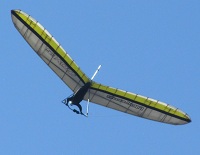
If a top notch 31m glider has a 70:1 glide. That is still 50x short.
Unfortunately, this isn't true.
Why? Because as one moves forward, the gravity vector (against which glide is defined) changes direction. Your answer assumes it remains unchanged. For any reasonable glide ratio, the change is in the noise, and can be ignored. But if you are talking about large glide ratios things don't work that way. This is espectially true if you are going "level" (orbit-like) and not dropping at all (relative to the earth's center, or MSL). Then you are talking glides long enough for the gravity vector change to matter.
For those more visually inclined, picture a "level" glide all around the earth. It is a circle, yes? That means that 1/2 way around the earth, the gravity vector has changed direction by 180 degrees. Clearly you can't use a straight line to approximate a circle except for a short distance compared to the radius of the circle.
For those who like to use energy arguments, consider this: If you remain on the circle, you don't require input of energy (friction asside.) If you deviate from that circle, you are rising or falling. Thus you require additional energy to rise (deviate upward from the circle). You also gain additional energy (as speed) when you deviate downward from the circle, as we normally do.
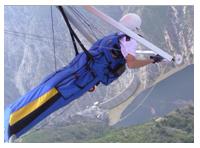
Still, a great photo, and an interesting idea that a circle the size of the earth deviates from a straight line by 1 part in 3750 over short distances. I didn't do the math before reading, and would have naively expected the glide ratio deviation to be larger.
Thanks for the mental exercise!